Most beginners treat the grinder as optional. They try to get by with hand tools, lose glass on curves that won’t cooperate, and eventually buy one anyway, usually two or three frustrating projects in. If that’s where you are right now, this guide will help you pick the right one. If you’re setting up for the first time, buy the grinder early. You’ll thank yourself later.
Over the last few weeks, I’ve tested several options to find the best stained glass grinder for beginners. An affordable option that will provide you with consistent grinding and perfectly round finishes.
But, before we get into all that, let’s discuss the importance of stained glass grinding and what you should look for in your first purchase.
Why the Grinder Matters
A glass grinder has a diamond-coated bit spinning in a shallow water reservoir. You press glass against the bit to smooth edges, adjust piece fit, and achieve curves you simply can’t cut freehand — if you want to understand which cuts need grinding support, the stained glass cutting guide covers exactly where scoring ends and grinding takes over.
Here’s the practical reality: no matter how good your scoring gets, glass doesn’t break with perfect precision. Pieces come out slightly too large, edges chip, curves drift from the pattern line, even if you’re using the best stained glass grinder there is.
The grinder corrects all of that. Without one, you’re fitting pieces by hand, which is slow, imprecise, and limits the complexity of patterns you can work with.
The other thing beginners underestimate is how much the grinder affects soldering quality. Pieces that fit properly produce tight seams. Tight seams produce clean solder lines. Gaps fill with ugly blobs of solder that weaken the piece and look bad. A grinder is indirectly responsible for how good your finished panels look.
What Makes the Best Stained Glass Grinder
Diamond Bit Quality
The bit is what does the actual grinding work. A good diamond bit removes glass efficiently, runs cool (the water helps), and holds up to regular use without losing its edge quickly. Cheap bits grind slowly and wear out fast.
Most grinders ship with a standard bit included. Mid-range and above grinders include decent bits. Budget grinders often include bits that need replacing within a few months of regular use. Factor that into the price comparison.
Reservoir Size
The reservoir holds the water that cools the bit and catches glass particles. A larger reservoir means less frequent refilling and more stable water level during long sessions. A small reservoir that runs dry mid-session is annoying at best and damages the bit at worst.
For beginner use, anything that holds at least half a litre is workable. Larger is better.
Table Size
The grinding table is the surface you rest your glass on while grinding. Bigger tables support larger pieces and give you more room to maneuver. For small beginner projects a compact table is fine. As your pieces get larger and more complex, table size becomes a real limitation.
An 8 inch table handles most beginner and intermediate work comfortably. A 10 inch table gives you more room. Anything smaller than 8 inches starts to feel limiting quickly.
Motor Strength
Cheap grinders have weak motors that bog down on thicker glass or during extended use. A stronger motor maintains consistent speed under load, which means consistent grinding results.
For hobbyist use you don’t need an industrial motor, but you want something that doesn’t slow noticeably when you apply firm pressure.
Best Stained Glass Grinder for Beginners: Top Pick
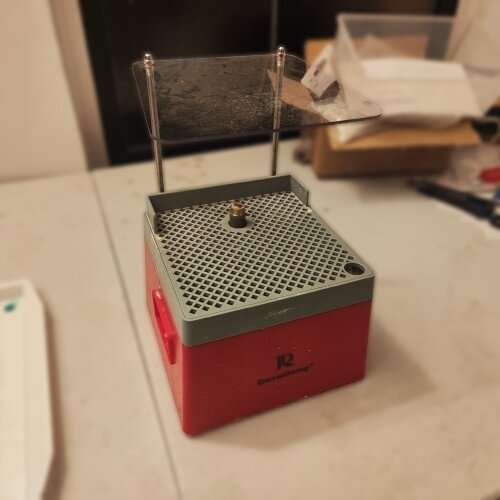
For most beginners and intermediates, a mid-range grinder in the $120 to $180 range is the right call. This price bracket gets you a decent diamond bit, an adequate reservoir, an 8 to 10 inch table, and a motor that handles regular hobbyist use without struggling.
What you’re looking for at this price: consistent motor speed, a reservoir that doesn’t need constant refilling, and a table surface that’s flat and smooth enough not to scratch your glass as you work.
[AFFILIATE LINK: top pick grinder]
Who it’s for: Anyone doing regular hobby work, beginner through intermediate. This level of grinder handles most patterns without limitation and lasts years with basic maintenance.
Budget Option: Does It Work?
There are grinders in the $60 to $90 range. They work, with caveats.
The motor is weaker and bogs down more easily. The bit is usually lower quality and needs replacing sooner. The reservoir is smaller. The table is typically more compact.
For someone who wants to try the hobby before committing more money, a budget grinder is better than no grinder. It handles simple patterns on standard glass thicknesses. Where it shows its limits is on thicker glass, extended sessions, and complex curves that require slow, controlled grinding.
[AFFILIATE LINK: budget grinder]
If you’re serious about the hobby — and if you’ve gotten this far you probably are — start with the mid-range option. The budget grinder often ends up being a stepping stone that costs almost as much as buying right the first time.
Features That Sound Good But Don’t Matter Much
Variable speed. Most hobby work happens at one speed. Variable speed sounds like a useful feature and rarely gets used.
Built-in light. The work area should have good overhead lighting regardless. A built-in grinder light is a minor convenience at best.
Eye shield. Almost every grinder includes one. Use it. But don’t pay extra for a fancier one.
Flex shaft attachment. Some grinders include an attachment for detail work on small pieces. Useful occasionally, not worth paying significantly more for.
Maintaining Your Grinder
A grinder that’s looked after lasts years. The basics:
Change the water regularly. Glass particles build up in the reservoir and become abrasive slurry that accelerates bit wear. Drain and rinse the reservoir every few sessions. Clean water keeps the bit running cleaner and longer.
Replace the bit when it stops cutting efficiently. A worn bit grinds slowly, heats up more, and leaves rougher edges. Replacement bits are cheap. Don’t run a worn bit longer than necessary.
Keep the table surface clean. Glass chips and grit on the table surface scratch glass pieces as you work. Wipe it down regularly.
Don’t run it dry. Grinding without water overheats the bit and ruins it quickly. Check the water level before you start every session.
Conclusion
Buy a mid-range grinder and buy it before you feel like you need it. No need to splurge on the best stained glass grinder that’ll set you back close to $200.
The projects you attempt before you have one are more limited and more frustrating than they need to be. Once you have one, you’ll wonder what you were doing without it. For a complete look at everything else in your setup, our stained glass tools guide covers every tool category with honest recommendations at different budget levels.
FAQ
Do I need a glass grinder for stained glass?
Technically no. Practically, yes. You can smooth edges by hand with a carborundum stone and make simple geometric pieces without one. But a grinder lets you fit pieces accurately, work with curves, and produce clean seams that solder well. Most beginners buy one within a few projects. Buy it sooner and skip the frustrating middle period.
What is the best stained glass grinder for beginners?
A mid-range grinder in the $120 to $180 range. This bracket gets you a quality diamond bit, adequate reservoir size, an 8 to 10 inch table, and a motor that handles regular use reliably. Budget grinders under $90 work but have weaker motors and shorter-lived bits. Mid-range is the better long-term investment for anyone taking the hobby seriously.
How long does a glass grinder bit last?
With regular hobbyist use and proper maintenance, a decent diamond bit lasts one to three years. The main factors are how often you grind, whether you keep the water clean and at the right level, and the quality of the bit itself. A bit that’s losing efficiency grinds slowly, produces more heat, and leaves rougher edges. Replace it when you notice those signs rather than running it until it fails completely.
Can I use any grinder for stained glass?
You need a grinder designed specifically for glass work. Standard rotary tools, angle grinders, and lapidary equipment aren’t built for the wet, flat grinding motion that stained glass requires. A dedicated stained glass grinder has the right bit type, water cooling system, and flat table surface for the job. Don’t substitute.